
Faculty of Law and Administration
University of Warsaw
History
Faculty of Law and Administration University of Warsaw
Beginnings
The traditions of the Faculty of Law and Administration, the oldest faculty of the University of Warsaw, date back to the 18th century and the curriculum of the Corps of Cadets. Plans to establish a university that would also educate lawyers were put forward at the time of the First Partition, when the Commission of National Education issued a series of professorial appointments. Financial and housing difficulties prevented this idea from being realized.
The idea was revived during the period when Poland lost its statehood. In 1808, the School of Law of the Duchy of Warsaw was established—mainly to serve the needs of the judiciary and administration which were being created from scratch. This date is regarded as the beginning of the Faculty’s history. On October 1, 1808, Feliks Łubieński, the then Minister of Justice, who was patronizing the organization of the school, emphasized its role as a center for educating young people. In 1811, through a merger with the School of Administrative Sciences, a two-faculty university was created: the School of Law and Administration. Its governance was entrusted to a Supervisory Board, which included, among others, Stanisław Staszic and Samuel Bogumił Linde. The
course lasted three years (or four in the case of combined programmes at both faculties). In 1814, the office of Dean was
introduced, and the distinguished legal historian Jan Wincenty Bandtki was appointed to this position. The School continued to operate without interruption even during the war with Russia. Transformed into the Faculty of Law and Administration on the basis of the 1816 founding charter, it became part of the Royal University of Warsaw. The University formally opened on 14 May 1818. Among the Faculty’s professors were the eminent economist and penitentiary Fryderyk Skarbek, Wacław Aleksander Maciejowski, who lectured on Roman law and historical and legal subjects, and finally, the Faculty’s own alumnus and the youngest criminal law
researcher in the group – Romuald Hube. The Faculty actively participated in the academic life of Warsaw, among other things by publishing the journal Themis Polska (1828–1831). During its 14 years of existence, the Faculty of Law and Administration produced 1,880 graduates, including 757 who received master’s degrees.
During the November Uprising, actual activity was suspended, and many lecturers and students took part in the military operations. As part of post-uprising repressions, on 19 November 1831 the University was closed. Efforts to rebuild legal studies met with strong resistance from the Tsarist regime. Temporarily, in 1840–1846, law courses were available at the gubernial gymnasium in Warsaw.
1862 – The Main School
During the reforms of the 1860s, the Russian authorities agreed to establish the Main School (Szkoła Główna) in 1862. The Faculty of Law and Administration became the largest of its four faculties. Its structure did not include a division into fields of study: law and administration, and only when taking the final master’s examinations it was possible to choose one of the fields offered. The group of professors at that time included, among others, criminal law scholars Stanisław Budziński and Walenty Miklaszewski; Roman law scholar Teodor Dydyński; civil law scholar Władysław Holewiński; and administrative law scholar Antoni Okolski. Over the course of seven years, 318 master’s degrees were awarded at the Faculty of Law and Administration (out of a total of 1,314 enrolled students).
1915 – The University of Warsaw
At the turn of 1869/1870, the purely Russian Imperial University of Warsaw replaced the Main School. Despite the failed attempts to establish a Polish university in 1905–1907, work on this project was resumed already during the wartime in 1914. Professors Miklaszewski and Holewiński, among others, participated in developing the concept of legal studies. On November 15, 1915, the
University of Warsaw was opened under the authority of the German occupation authorities. Its first faculty (until the launch of the Faculty of Theology) was the Faculty of Law and State Sciences—renamed in 1917/18 the Faculty of Law and Political Sciences.
An alumnus of the Main School, Alfons Parczewski, was appointed Dean. Studies at the Faculty were launched gradually, with lecturers being hired annually for subsequent semesters.
In 1918, steps were taken to fully stabilize the University. The scope and procedure for taking examinations were defined for the Faculty of Law. In January 1919, the Head of State signed a decree appointing the first body of professors of the University of Warsaw, which abolished the positions of contracted lecturers. The appointed professors assumed leadership of institutes (for legal disciplines referred to as “seminars”), and work began that continued uninterrupted for 90 years.
In 1920, the University adopted rules for appointing professors and associate professors similar to those at other state universities. The departments (seminars) of the Faculty (including two chairs created ad persona: sociology of law -Prof. Leon Petrażycki, PhD, and the history of social systems – Prof. Ludwik Krzywicki, PhD) operated in very difficult conditions. Not all chairs were fully staffed, and many lectures were entrusted to visiting professors. In 1920, the faculty included former professors of the Main School as
honorary professors: Teodor Dydyński, Władysław Holewiński, and Walenty Miklaszewski. Alongside professors who began their academic careers in Lviv (such as Ignacy Koschembahr-Łyskowski, Antoni Kostanecki, and Zygmunt Cybichowski) or Edward Strasburger, who came from the Jagiellonian University, the chairs were also taken up by younger scholars who bound their careers to the Faculty. From 1917, the lawyer Wacław Makowski, co- author of the criminal law codification and involved in parliamentary activities, joined the staff; from 1935 he also held the chair of constitutional law. From 1921, Roman Rybarski author of valuable works, actively participating in parliamentary life, and at the same time, from 1937/38, dean, took over lectures and then the chair of treasury. At that time, there were lively scientific ties with foreign centres, especially with French science. From 1932, a one-semester lecture on French civil law was given by Prof. Henri Mazeaud, a professor at the Faculty of Law of the University of Lille, and when the chair of French civil law was established in 1935/36, the professor took it up as a full professor at the Faculty of Law of the University of Warsaw. The outbreak of war in 1939 interrupted his lectures.
The number of students in the interwar period was very large (admissions ranged from 2,000 to 3,000), with approximately 30% of those enrolled in the first year completing their studies. In 1933, the Faculty limited the number of new admissions to 1,000 by introducing a secondary school leaving examination competition. The basic teaching format comprised lectures and seminars; broad implementation of practical classes was achieved only in 1937 by Dean Rybarski (thanks to positions partly funded from
student fees). Examinations at the end of each academic year were taken on a single day; a retake was allowed in one subject, while more failing grades meant repeating the year.
The Faculty operated under very difficult housing conditions. It was not until 1935/36 that it was given a newly constructed Faculty of Law building, which included the Auditorium Maximum.
1939
In September 1939, the Faculty of Law’s seminary building was destroyed by the fire. The German army occupied the Auditorium Maximum as well as the surviving premises of the Civil Law Seminary. As early as October, in response to Dean Rybarski’s inquiry, the heads of institutes declared that classes could resume once substitute premises were secured. At the end of October, however, the Germans banned the operations of higher education institutions, and organizing underground teaching required new methods.
From the autumn of 1940, classes for senior students were held under the supervision of Dean Rybarski. For those wishing to begin their studies, courses were organized together with professors displaced from Poznań as part of the University of the Western Territories, where from January 1, 1941, Prof. Rafacz served as Dean of the Faculty of Law. When Rybarski was arrested in May 1941,
teaching was temporarily suspended, but by July 1941 it resumed under the guidance of Prof. Rafacz as Dean of the UW Faculty of Law. The law courses of the University of the Western Territories were gradually transferred to the University of Warsaw, so that by 1943 the Faculty of Law was fully functioning within the University of Warsaw and the number of students steadily increased. It is estimated that approximately 1,000 students studied during the occupation (a list based on passed exams includes 600 names).
Small groups were formed in various locations across the city, and professors repeated classes on a given subject several times. Each subject ended with an examination, but organizing examinations for all subjects in a given year on a single day was impossible under occupation. The Faculty of Law was the only faculty where Faculty Council met regularly, and alongside teaching, professors also pursued scholarly work, preparing textbooks. The Warsaw Uprising interrupted the course of teaching, and Dean Rafacz was killed in August 1944, executed by the Germans. After the end of the war, professors gradually returned to Warsaw.
After 1945
In July 1945, classes resumed at the Faculty of Law, continuing with the existing curriculum (while retaining separate examinations for each subject). The professorial ranks expanded. From 1950, all chairs were fully staffed; new chairs were created: in 1946-statistics, history of the l Western European law, military law; in 1947—ancient law; in 1949—criminology. In 1952, the chair of
ecclesiastical law was abolished and a chair of agricultural law was created. Some chairs were renamed, e.g., in 1949 the chair of the encyclopaedia and philosophy of law was renamed the chair of legal theory. The term “departments” (zakłady) was introduced (in place of chairs), which in the 1950s became parts of institutes or groups of chairs formed alongside independent chairs. From 1968,
all chairs, as departments, became parts of Institutes. Since then, the Faculty has worked within a structure of six Institutes.
The number of professors grew from a dozen or so to several dozen in recent years. Professors actively participated and continue to participate in scholarly life, among other things by preparing academic systems and textbooks and authoring numerous monographs. Among them, in 1947–1952, was the eminent Roman law scholar and the founder of Polish papyrology, Rafał Taubenschlag; after his death, the Department of Ancient Law, which merged with the Department of Roman Law in 1962, was for many years headed by Prof. Henryk Kupiszewski. Between 1949 and 1964, the Department of General History of the State and Law was headed by Prof. Karol Koranyi, and between 1965 and 1977 by Michał Sczaniecki. The history of Polish law is associated with the names of Prof. Bogusław Leśnodorski, Prof. Jakub Sawicki, and currently Prof. Juliusz Bardach. In the field of criminal law, Professors Stanisław Śliwiński, Jerzy Sawicki, Igor Andrejew, Leszek Lernell, Stanisław Batawia, Stefan Kalinowski, and Alfred Kaftal made their mark on the Faculty’s history; in the field of civil law Professors Jan Wasilkowski, Seweryn Szer, Witold Czachórski, Roman Piotrowski, Witold Warkałło, Zbigniew Resich, and Jerzy Jodłowski; in international law: Professors Cezary Berezowski, Manfred Lachs, and Wojciech Góralczyk; in constitutional law: Professors Stefan Rozmaryn and Jerzy Stembrowicz; in administrative law: Maurycy
Jaroszyński, Jerzy Starościak, Zygmunt Rybicki, Jerzy Służewski, and Ryszard Malinowski. The examples listed here do not exhaust the list of scholars associated with the Faculty; one should also consider currently serving staff who have achievements in the field of scientific research and participate in international scholarly life and in various spheres of public life. Among the Faculty’s professors
were members of the Polish Academy of Arts and Sciences such as Professors Rybarski and Śliwiński, Taubenschlag, Lachs, Rozmaryn, Wasilkowski, Batawia, Leśnodorski, and Czachórski, and currently Juliusz Bardach and Sylwester Zawadzki, members of the Polish Academy of Sciences.
The Faculty published its own journal—since the 1920s, it was called “Themis Polska III” (referring to the tradition of the first “Themis Polska” from 1828–30). After World War II, publication of the journal was resumed in 1972 as a series under the new title “Studia Iuridica.” To date, 47 volumes have appeared.
Faculty professors have actively participated and continue to participate in international academic life. Noteworthy examples include membership in the Hague Academy of International Law; cooperation with the International Faculty of Comparative Law in Amsterdam and the International Academy of Comparative Law in The Hague; participation in the Permanent Court of Arbitration in The Hague during the interwar period; and the International Court of Justice after World War II. Strong ties with French legal scholarship were also renewed after the war starting from the 1950s, with the organization of Polish-French Law Days in cooperation with French universities. Since the 1970s, the Faculty has also organized Polish-British Days. Between 1979 and 1990, the Faculty ran a Summer School of Law for foreign students from American universities. In 1992, the first Centre for the Study of English Law in Europe was established at the Faculty, operating as the Centre for English and European Law. In addition, there are the Centre for French and European Law, the Centre for German and European Law, and since 1998/99 the School of American Law, as well as the School of Italian Law, the School of Spanish Law, and Polish Law for foreign students. At these schools, senior students can explore foreign legal systems under the guidance of foreign professors.
With regard to the organization of studies after World War II, changes began to be introduced in 1948. From that year, three
tracks were offered for third-year students: civil law, criminology and administration. From 1949, a two-cycle system was
introduced: the first cycle lasted three years, was vocational in nature, and entitled graduates to pursue master’s studies in their chosen specialization (for which a limited number of places was available). Students who were not admitted to a specialization were allowed to complete their studies as external students in later years. The two-cycle system was abolished in 1951/52, and four-year studies were reinstated. Since the 1980s, studies have lasted five years and conclude with a master’s thesis defence. In 1951, the Extramural (Part-Time) Studies Programme of the Faculty of Law were established and operated until 1996, with consultation centres in Białystok and Olsztyn. In 1959, the Vocational Administration Studies Programme was established, and in 1964, a two-year master’s degree Study of Administration for graduates of the Vocational Administration Studies Programme. In 1968, Postgraduate Study in Administration was established. Consultation centres for administrative studies were operated in Białystok, Łomża, Ostrołęka, and Płock; currently, the Higher School of Public Administration in Ostrołęka operates under the patronage of the Faculty.
Since 1992, the Faculty has undertaken toincrease the number of students admitted to its programmes. Uniquely in Poland, it introduced classes for both full-time and so-called evening studies under a unified programme, abolished the discipline of classes, and replaced exercises with “consultations” in groups of various sizes (depending on the size of the rooms available), open to students of both modes. Compulsory practical classes in specific subjects were introduced for second-year students. In 1993/94, 150 fee-paying students were admitted to evening studies after passing an entrance exam; and since 1993/94, 800 students have been admitted on the basis of a secondary school leaving examination (matura) competition. The Faculty continues to seek the best recruitment methods. The primary group comprises students admitted to tuition-free studies based on an entrance exam. Since 2006, entrance exams have been abolished and admissions are based on matura (secondary school leaving examination) results.
After World War II, the Faculty did not have its own headquarters, as both the Seminary building and the Auditorium Maximum were destroyed. The renovated seminary building was returned to the Faculty in the late 1940s. The rebuilt Auditorium Maximum was allocated to all faculties of the University of Warsaw. In the late 1960s, there were plans to construct a new building on Szturmowa Street (in the distant Mokotów district), which met with opposition from both students and staff. In the 1990s, the Faculty took the initiative to construct a building for teaching purposes, allocating a large share of evening students’ fees for
this purpose. Classes in the new building at 4 Lipowa Street began in October 1998.
In subsequent years, with co-funding obtained under the Integrated Regional Operational Programme, a building at Oboźna Street (Collegium Iuridicum III) was erected, housing the Institute of Legal and Administrative Sciences and a modern Faculty Library with reading rooms for students and academic staff. The Faculty also participated in the adaptation of the Old University Library building in Warsaw on the Main Campus of the University of Warsaw, gaining modern teaching rooms on the second floor.
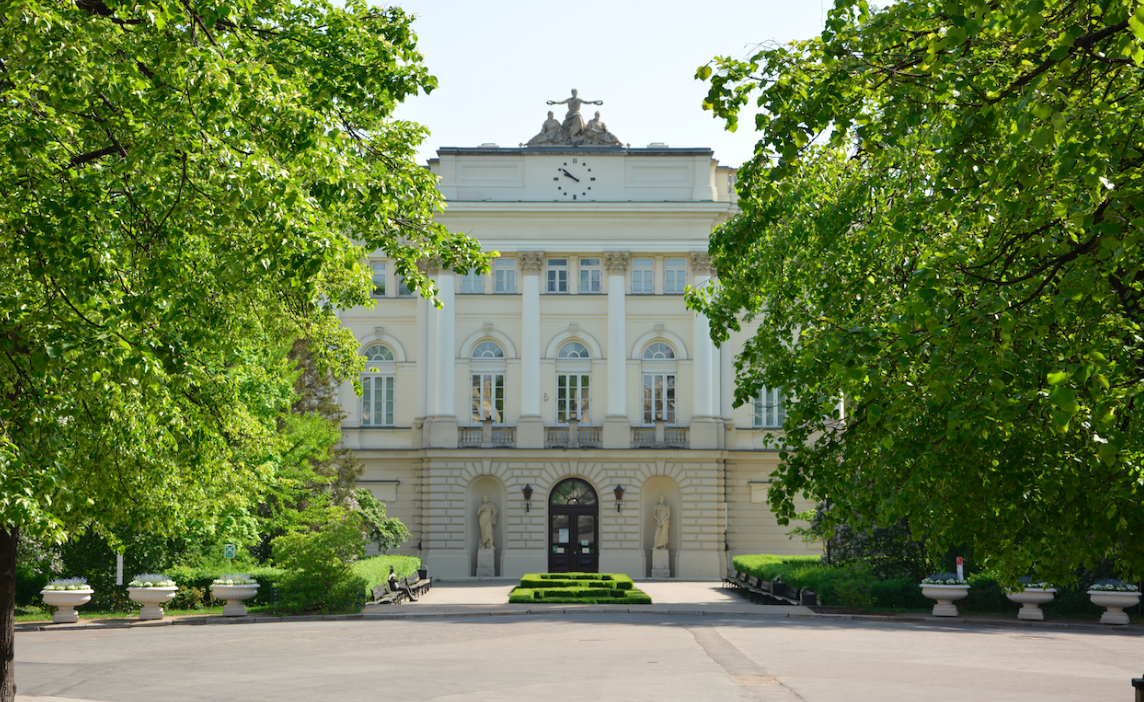
In 2010, the major renovation of the Collegium Iuridicum I seminary building was completed. On 4 March 2011, the Collegium Iuridicum I building was ceremonially named after Prof. Leon Petrażycki.
On 27 June 2011, the University and Faculty authorities held the ceremonial opening of the Collegium Iuridicum IV building located at 47 Wybrzeże Kościuszkowskie Street. The building has four lecture halls and a seminar room. It will house the Institute of International Law.
Prepared on the basis of a text by Prof. Grażyna Bałtruszajtys, PhD.